Singapore, June 2, 2026– Allied Telesis, a global leader in secure, high-performance networking for industrial and enterprise applications will showcase its latest AI-ready retail connectivity solutions at NRF’26 APAC—Retail’s Big Show Asia Pacific: The Next Now—at Booth 2121.

Retailers across the Asia-Pacific region are rapidly transforming store operations to support connected experiences, AI-driven applications, and increasingly complex digital infrastructure. At NRF’26 APAC, Allied Telesis will demonstrate how retailers can modernize store connectivity with secure, scalable wired and wireless networks built for today’s high-performance retail environments.

As retail networks evolve, businesses require infrastructure that delivers reliability, flexibility, and secure connectivity across every store location. Allied Telesis provides AI-ready networking solutions that help retailers support high-density environments, streamline operations, and accelerate digital transformation initiatives.

“Retail organizations need networks that can scale with evolving customer expectations and operational demands,” said Antonella Santoro, VP of Marketing at Allied Telesis. “At NRF’26 APAC, we look forward to discussing how secure, interoperable networking infrastructure can help retailers build resilient, future-ready store environments.”

Visitors to NRF’26 APAC are invited to visit Allied Telesis at Booth 2121 to explore how secure, AI-ready networking can support retail transformation initiatives and enable the next generation of connected retail experiences.

For more information visit AlliedTelesis.com

MUNICH, GERMANY – October 5th, 2017 – Allied Telesis, a leading provider of hardware and software products that allow customers to build secure, feature-rich and scalable data exchange solutions, enjoyed considerable success at the recent Multi-Access Edge Computing (MEC) Congress Edge Awards in Berlin by collecting two first-place awards for its Envigilant platform, which integrates MEC technology with specialized safety and security applications.

Held on September 26th, the 2017 MEC Congress focused on how today’s network operators utilize edge computing to deliver IoT applications and services to their customers, to drive automation and reduce operational costs.

Allied Telesis won the Best Edge Computing Technology award for its Envigilant Sensor Platform (ESP). ESP is an IoT gateway that delivers tailored edge-computing capabilities through the tight integration of hardware, software, services and support for customers in the manufacturing, security, smart city and transportation IoT markets. An ESP device is capable of withstanding harsh environments, vibration and elevated temperatures and provides immediate access to real-time information for process operations personnel at the network edge.

Allied Telesis also won first place in the Most Successful MEC Partnership category for its work with the Santa Clara Valley Transport Authority (VTA) and Levi’s Stadium prior to the 2015 Super Bowl in San Jose, California, USA. Miniaturized ESP devices were deployed to provide situational awareness throughout Santa Clara County and a common operating picture for VTA, Levi Stadium security operations and public safety agencies. The partnership between Allied Telesis and the VTA continues today, providing safe transportation and immediate passenger information throughout the VTA network.

“We’re delighted to have been recognized by the MEC Congress Awards Committee for our work on the Envigilant Sensor Platform. It validates our integrated approach to edge computing and visualization,” said Jakub Duch, Vice President for International Sales at Allied Telesis.

“As more enterprises explore the potential of IoT as a process automation and productivity driver, the demand for powerful edge computing solutions will increase. We think we’re in a good position with Envigilant and the MEC judges seem to agree.”

This is the second time that Allied Telesis has received multiple awards for its advanced data exchange solutions this year. At the NFV Europe Conference in June 2017, Allied Telesis collected two first-place awards and a runner-up award for its AMF Security (AMF-Sec) network management and security solution.

The Internet of Things (IoT) is currently revolutionizing entire consumer and industrial applications by enabling them to take advantage of data and services provided by the billions of internet-connected objects. One of the main enablers of the IoT revolution has been integrating IoT devices with cloud computing infrastructures, which has empowered IoT applications to leverage the scalability, capacity and Quality of Service (QoS) of the cloud. Currently, all major cloud vendors provide support for hosting IoT applications and enable IoT vendors to offer their services based on pay-as-you-go modalities such as Software-as-a-Service (SaaS) and Platform-as-a-Service (PaaS).

Nevertheless, IoT/Cloud integration comes with its limitations, which make it inappropriate for certain use cases, notably requiring real-time field processing and control. These limitations include:

  • Inefficient bandwidth use, as not all IoT data need to be streamed and stored in the cloud, given that only a limited subset of them has actual business value.
  • Network latency is caused by the interaction of IoT devices with the cloud makes this unsuitable for real-time applications.
  • Waste of storage, since excess data without essential business value, are stored in the cloud (e.g., in cases of sensors recording values that do not change frequently).
  • Limited privacy-friendliness, as IoT/cloud deployments provide no easy way to isolate private sensitive datasets.

In order to alleviate these limitations, there is a need to move computation closer to your users and the field by introducing additional layers of processing between the cloud and the field.

Industry 4.0 Edge Computing using hand held device

Edge Computing Characteristics and Rising Momentum

During the last couple of years, several approaches to deploying computation close to the field have been introduced, including Fog Computing, Cloudlets, and Mobile-Edge Computing. Despite their different names, they all entail the deployment of a layer of computational nodes at the very edge of the network i.e. close to the users and between the field and the cloud. Hence, we conveniently consider these approaches as different instances of the “edge computing” paradigm.

Edge computing is characterized by one or more layers of edge nodes (i.e. gateways) that are deployed between the cloud and the IoT devices, including gateways close to the field. The gateways can be of different types, ranging from embedded controllers and IoT devices with limited processing capacity to entire clusters of computational nodes. The exact types of nodes to be deployed and used depend on the target application’s nature. In general, the proper deployment of edge nodes can provide several benefits, including reduced latency for real-time applications, more efficient use of bandwidth and storage resources, enhanced scalability, reduced energy costs, improved environmental performance, and better opportunities for privacy control and data protection.

Edge computing is gradually becoming the preferred choice for architecting large-scale IoT systems in industrial and consumer settings, including smart grids, smart manufacturing, intelligent transport, smart cities, healthcare, and more. Recently, standards development organizations – such as the Industrial Internet Consortium Reference Architecture and the OpenFog consortium – have started to promote the use of edge computing as part of their reference architectures for IoT deployments. At the same time, equipment manufacturers like us are working hard to provide configurable, standards-based edge computing platforms which can be flexibly deployed in different environments.

Application Examples

Edge computing is mandated in the case of the following types of IoT deployments:

  • Large-scale distributed control systems integrate location-aware functionalities with real-time processes in order to support scalable, low-latency control operations.
  • Privacy-sensitive multi-user applications leverage the data isolation capabilities of edge computing in order to minimize the transfer and processing of privacy-sensitive datasets in the cloud.
  • Mobile applications enable roaming users and fast-moving objects (e.g., connected trains and self-driving vehicles) to interact with edge nodes in their vicinity and to benefit from access to local resources.

Two practical example applications with some of the above-listed characteristics follow:

Urban Security and Surveillance Applications

These are data-intensive applications that perform real-time processing of multimedia streams (e.g., video) stemming from many surveillance spots. They typically cover large areas such as metro networks, multiple office locations, metropolitan districts, and more. These applications can adaptively process video streams locally by spawning application logic across several edge computing nodes/clouds. Video is streamed to the cloud with very high frame rates whenever a potential security incident is detected; else, low frame rates are used. To this end, data are processed at the edge based on advanced streaming queries, which include pattern detection capabilities on images and video. In this way, edge processing facilitates real-time processing for the timely detection of security incidents while simultaneously leading to huge bandwidth and storage savings in the cloud. In such deployments, it’s important for edge nodes to offer deployment flexibility in order to facilitate their installation in different environments. Likewise, it’s important to facilitate the deployment of different algorithms for detecting events in varying conditions and contexts (e.g. day/night time, face detection, image analysis, etc.).

Digital Factory Automation Applications

In smart manufacturing deployments, real-time insights into production processes and their schedules are often needed. This is essential for supporting new production models such as mass customization. Edge computing deployments in factories can provide human operators with real-time edge analytics insights about their work in a given station to enable rapid validation of production processes and prompt identification of problems while simultaneously boosting their decisions about the next steps in the production process. Likewise, they can also simulate parts of the production process at the edge in order to provide insights on quality control, failure modes, and maintenance operations, notably in terms of the station’s equipment.

The Future of Edge Computing

As reflected in its market figures, industrial momentum, and standards, edge computing is growing quickly. In the coming years, the importance of edge computing will continue to rise as it will become an essential building block for applications that will dominate the market. The latter include connected cars, self-driving vehicles, and a wide range of Industry 4.0 applications in manufacturing shopfloors, energy plants, oil refineries, and more. Moreover, edge computing will empower entire new paradigms for IoT applications, including paradigms involving Artificial Intelligence and Smart Objects such as industrial robots, assistive robots, smart pumps, smart wearables, and more. Smart objects will exhibit semi-autonomous behavior but can still interact with IoT/cloud platforms via appropriate edge nodes.

With appropriate cybersecurity measures in place, edge computing will enable the proliferation of applications that entail real-time actuation and control, which is one of the key value propositions of IoT. Indeed, IoT applications are not only about deriving insights and knowledge from IoT data but also about closing the loop to the field and influencing the physical world.

SAN JOSE, CA – April 11, 2018 – Allied Telesis, a leading provider of hardware and software products that allow customers to build secure, feature-rich and scalable data exchange solutions, today announced the signing of a value added reseller agreement with Echelon Corporation (NASDAQ: ELON). Under the terms of the global agreement, Allied Telesis will be authorized to incorporate Echelon’s intelligent lighting solutions into its smart city and smart campus projects, and Echelon’s industry leading IoT products into Allied Telesis’ other projects requiring building automation and controls.

In major cities, buildings are responsible for approximately 30 percent of global greenhouse gas emissions and 70 per cent of energy consumption. To better align with climate and sustainability goals, and to help improve public health and safety, smart cities are looking to smart building technologies to drive impactful changes in facilities management.

« We’re seeing strong demand for our Envigilant Sensor Platform (ESP) and the advanced data collection, analytics and visualization capabilities it delivers to manufacturing, regional transit and public safety customers,” said Taki Oshima, Chairman and Chief Executive Officer at Allied Telesis. “This agreement with Echelon will allow us to extend Envigilant’s capabilities to the smart building market, where reducing energy consumption and associated costs is a priority for public and private owners.”

Echelon’s intelligent lighting solutions turn otherwise ordinary LED streetlight retrofits into 21st century smart city networks capable of fine-tuned control, and can form the basis for future smart city applications. The company’s Industrial IoT solutions for building automation and controls include SmartServer™ IoT, the first edge server to incorporate the most common industrial device protocols. This allows existing and new networks of such devices to seamlessly connect to the cloud and make their data available for use by modern analytics and AI engines.

”We look forward to extending our global reach to prospective customers with Allied Telesis for intelligent lighting and IIoT projects,” said Ron Sege, Chairman and Chief Executive Officer of Echelon. “Allied Telesis’ solutions-based philosophy and reputation for reliability are perfect fits for our markets.”

About Echelon Corporation

For 30 years Echelon (NASDAQ:ELON) has pioneered the development of open-standard networking platforms for connecting, monitoring and controlling devices in commercial and industrial applications. With more than 140 million connected devices installed worldwide, Echelon’s solutions host a range of applications enabling customers to reduce energy and operational costs, improve safety and comfort, and create efficiencies through optimizing physical systems. Echelon is focusing today on two IoT (Internet of Things) market areas: creating smart cities and smart campuses through connected outdoor lighting systems, and enabling device makers to bring connected products to market faster via a range of IoT-optimized embedded systems. More information about Echelon can be found at www.echelon.com.

The wireless edge of the network has become ubiquitous, and so too have our expectations of a reliable and secure connection. As we have become used to the convenience of connecting wherever and however we want, we tolerate the flaws in a typical Wi-Fi connection—pauses in downloads, occasional drop-outs where we must re-connect, and lengthy waits as we try to join a public Wi-Fi network. For our personal browsing, we make a conscious compromise between convenience and reliability because apart from being frustrating at times, no real harm is done. But in a business environment, reliable wireless connectivity can’t be a compromise for critical operations, especially where it can be the difference between life and death.

Why multi-channel is not always the best choice

Most Wi-Fi networks operate on a multi-channel architecture (aka “micro-cell”), where each wireless access point (AP) connects to a mobile client using one of several radio channels. To achieve optimal throughput to each client, it’s important to have good signal strength but minimal radio interference by ensuring that the APs are not too close, and the same radio channels do not overlap (called “co-channel interference”). However, this can be difficult when there may be physical layout constraints, and there are only a few channels to choose from – and even harder in a multi-tenancy building when your neighbor chooses the same channels as you! To assist with this, tools are used to survey the physical site to plan the channel map for the optimal experience, but these tools can be expensive and time-consuming to use effectively. This is how typical Wi-Fi networks are designed, and why they occasionally exhibit reliability glitches.

Some years ago, an alternative architecture was proposed that utilized the same radio channel for all APs in the network. In this model, the placement of the APs was no longer critical because they all used the same channel, so interference was not an issue. If coverage was poor in one location, then additional APs could be easily deployed without worrying about introducing bandwidth-destroying interference. Although the single-channel architecture solved one of the biggest challenges of Wi-Fi network design, it too had some limitations, the main one being that its total network throughput was usually lower than multi-channel.

Since then, multi-channel Wi-Fi has become the predominant architecture and most of the time, it does a great job. However, there are some situations where multi-channel is not the best choice, and alternative solutions can provide a better experience. Applications of this type usually fall into three categories:

  1. Dynamic physical environments, like warehouses, where radio coverage is continuously being changed as objects are moved and removed. This makes multi-channel planning almost impossible, so the workaround is to deploy more APs. Unfortunately, this not only increases cost, but it introduces more radio interference, which reduces data throughput.
  2. Environments that must have reliable connectivity to mobile devices, like hospitals, where even a momentary loss of data connectivity can have a serious effect. As a wireless client moves, its connection will “roam” to another AP when it perceives a significantly more attractive signal. Unfortunately, this roaming process can sometimes be slow and disruptive as security credentials must be established or re-negotiated. Often this can manifest as an annoying lag on a VoIP call, or random artifacts in video. One solution is to use only wireless clients that support “fast-roaming” protocols, or intelligent bridging devices that handle the roaming on behalf of the client. Both these solutions add complexity and cost.
  3. Environments where there are many roaming wireless users, like schools, hospitals, public venues, etc. Multi-channel struggles to cope in these situations because only one client can talk to an AP at a time. So, having more clients associated with an AP means there is less time for each client to talk, so the effective bandwidth to each client is reduced. Adding more APs doesn’t always help because co-channel interference increases, which also reduces bandwidth.

What’s needed is a cost-effective Wi-Fi solution that combines the best features of both architectures: multi-channel’s throughput with single-channel’s easy deployment and reliable, seamless roaming connectivity.

Luckily, there is a solution that allows the user to select multi-channel, single-channel or both, for the optimal Wi-Fi experience. Previously, users had to choose one architecture or another, and where it was desirable to run both multi-channel and single-channel systems on-premises, they had to manage two different networks with different tools. Administration efforts were increased because firmware updates had to be applied twice, and engineers had two different systems to learn and maintain.

Hybrid Wireless

Now, with the new Hybrid Wireless solution from Allied Telesis, a Wi-Fi network can be deployed with a mix of channel architectures and administered using the same management tool. Using the name “Channel Blanket” for the single-channel architecture, the Hybrid Wireless APs can offer both multi-channel and Channel Blanket at the same time! Operating at the fastest Wi-Fi speeds available today, they are the ideal choice for reliable Wi-Fi in the challenging environments described above:

  1. In a dynamic environment, Channel Blanket APs can be deployed in greater numbers than multi-channel APs because their single radio channel does not introduce interference. If greater bandwidth is required then the APs can be configured to support up to 3 blankets concurrently, which significantly increases capacity in dense AP environments.
  2. Channel Blanket has the advantage in an environment that requires reliable roaming too. With single channel, all APs in the network appear as if they are a single AP, so the mobile client only sees that it is connected to one large AP. When the client moves, the Wi-Fi controller assigns it to a new AP, so the client is unaware of the “roam” and needs no special features to support it (e.g. fast-roaming protocols). Not only does this simplify the client, but it means the Wi-Fi connection is not interrupted by the move, and no latency is introduced, or data lost. Note that although new standards have been ratified to facilitate better roaming (e.g. IEEE802.11k/v/r), only high-end, modern wireless clients support these standards (e.g. iPhone6 with iOS7 and later). Clients that do not support these standards will still experience some disruption or data loss when roaming on multi-channel wireless networks.
  3. In an environment with a high client density, Channel Blanket can increase the available bandwidth by enabling more APs to be installed in the same area without introducing co-channel interference. Although this is possible with multi-channel too, Channel Blanket solutions require no channel planning so installation and management are much easier.

Until now, customers that required industrial-grade Wi-Fi, high-density coverage or seamless roaming had to make a choice between multi-channel and single-channel architectures. With multi-channel, high client density is difficult to achieve, and you risk having wireless clients that do not support fast roaming protocols; with single-channel, you risk using an “unconventional” solution requiring disparate management tools. To mitigate these risks, customers wanted to use both architectures together, but until now, this required two different wireless systems or many complex workarounds, which were cost-prohibitive.

A better Wi-Fi experience

The new Allied Telesis hybrid wireless solution uniquely enables customers to configure both architectures simultaneously on the same hardware to best suit their specific application. Customers now have the flexibility to configure their wireless LAN to provide multi-channel coverage for some clients and Channel Blanket for others—useful when some clients want the best bandwidth, and others need seamless roaming for nonstop connectivity. Combined with our innovative Autonomous Wave Controller (AWC), which is a unified, easy-to-use management tool that continually tunes the APs for optimal coverage, the Hybrid Wireless solution is an effective alternative to the compromises and workarounds of multi-channel Wi-Fi.

To find out more about Hybrid Wireless and how you can have a no-compromise Wi-Fi experience with reduced administration effort at a reasonable cost, contact us.

Dubai, UAE – September 19, 2019, Allied Telesis, a leading provider of hardware and software products that allow customers to build secure, feature-rich, and scalable data exchange solutions, has continued the restructuring of its Middle East operation.

Joining the Middle East team is strategic networking specialist Kenneth Torp. Kenneth brings over 25 years experience in the networking industry and joins Allied Telesis as Senior Vice President of the Middle East region.

“Our commitment to the Middle East region has never been greater”, said Torp. “We are in the process of building Global Alliance partnerships that will see Allied Telesis continue to grow throughout the region” he added.

Allied Telesis has won several major contracts in the region recently and has built a solid reputation for working well with partners to deliver a variety of key projects, with a specialty for reliable and secure video surveillance solutions. “We have the technology, we have the solutions and we have the partners in which to deliver, and we look forward to expanding our business base to offer more services in the future”, said Torp.

Contact information:

Kenneth Torp
Senior Vice President of Sales – Middle East
Allied Telesis Middle East Ltd
Office No. 120 Building No. 12, First Floor
Dubai Internet City
United Arab Emirates
Tel: +971 4 454 8740

Over the past decade, video surveillance and security systems have come a long way, thanks to the increasing ubiquity of the Internet Protocol (IP) and the Internet of Things (IoT). Sending and receiving data directly over the Internet and offering advanced features like motion sensors, cloud storage, video analytics, and automatic notifications, these systems provide reliable protection for industrial and manufacturing facilities, government offices, and more.

But despite their benefits, IP video systems also come with significant security risks if they use public infrastructure because they give cybercriminals easy attack pathways. They also have diverse topologies and technologies that make them more complex and increase their « attack surface. » Ultimately, they make users vulnerable to Distributed Denial of Service (DDoS) and Man in the Middle (MitM) attacks, privacy violations, malware installations, and data leaks.

Considering the amount and scale of information that government bodies collect on citizens, threat actors are always looking to steal or expose data-rich records – as six US government departments (including energy, commerce, treasury, and state), found to their shock in mid-December 2020. In 2019, 54% of manufacturing companies also experienced data breaches or cyber-attacks, indicating that they are also not safe from these risks*.

Since IP video surveillance systems are not 100% secure, what can manufacturing facilities and government agencies do to minimize their risks and protect their premises, data, and users? There is no single ideal strategy, so a program to safeguard these systems should include multiple strategies, like the five discussed below.

Leverage Intrusion Detection and Prevention Systems

As part of a robust cyber-defense strategy, antivirus software should be installed on user terminals and Digital Video Recorders (DVRs) to detect and prevent the spread of malware infections. In non-distributed Physically Open Circuit (POC) topologies – where network hosts like cameras and DVRs have public IP addresses – a Network Intrusion Detection System (NIDS) can detect malicious or anomalous traffic patterns that may indicate the presence of a hacker. VPN firewalls like the next-gen UTM firewall from Allied Telesis can be an easy way to implement a NIDS to blocks threats and encrypt critical network traffic.

Encrypt Data for Secure Transmission

All video feeds, plus information like usernames and passwords should be encrypted to protect the data-in-transit, particularly if it traverses the Internet. There are many encryption options available, but the most common are SSL/TLS for user information and IPsec or MACsec for data. Proper encryption helps prevent eavesdropping and packet manipulation that can happen during a MitM attack.

Data provenance (proving the source of the data) and using digital watermarks to ensure the video content’s integrity can also mitigate data tampering. Another approach is to proactively detect and deter eavesdroppers’ presence using a feature such as Active Fiber Monitoring from Allied Telesis.

Implement Strong Passwords and Multi-Level Access

Strong passwords should be a critical element of the system’s security framework. Length, complexity, and regular changes are critical to a password’s strength. This is especially important if the device uses port forwarding for access.

For additional security on administrator accounts, multi-factor authentication is an excellent choice. The password is more robust because the user must provide additional unique information, like an SMS code, and they receive a notification on every access attempt.

If several users access the video feeds, the system must provide different levels of password-protected access. Some authorized users may have device-specific access, so they can only view images from those devices, while others may have operator-level access. A few may have access to administrator or control all settings like new account creation, changing camera direction, adding new cameras to the network, etc.

Keep Software Up to Date

Every IP video surveillance system needs occasional software updates to maintain its security. Firmware updates may be released regularly or occasionally as part of a device’s patch release for a specific vulnerability. It is essential to register the device on the manufacturer’s website to get reminders for all these updates, which should be downloaded and executed immediately.

The process of updating firmware can be disruptive to the network’s operation because device reboots stop the video stream, and updating many devices can be time-consuming and risky on large networks. Therefore, it is important to consider features that help minimize disruption and automate the update process.

Allied Telesis has created Continuous PoE, which maintains the power supply to a connected device, like a camera, during a switch reboot. This minimizes the outage duration and gets the video stream flowing again without waiting for the camera to restart.

Autonomous Management Framework Plus (AMF Plus) is an automation solution from Allied Telesis that simplifies the installation and management of large-scale networks. Amongst its many capabilities are automated firmware upgrades, which can roll out updates with minimal disruption and no manual intervention. So, the network will update while the administrator sleeps!

Train Users on Security Practices

As with any other network or device, people are the weakest link in an IP surveillance system’s security profile. Therefore, it is crucial to develop and document cybersecurity guidelines and policies and provide cybersecurity training to all users who will access the system. Users should be educated on the potential attack vectors and what they need to do to stay safe from potential attackers’ requests under false pretexts. They should also be aware of the risks of accessing the system—say via a mobile app—on an unencrypted public Wi-Fi system.

It is vital to stay current with the latest cybersecurity standards and best practices at an organizational level and ensure they are followed at every level. We have partnered with NUARI to offer the latest cyber threat defense education customized to your organization’s specific requirements.

Wrap Up

Due to low ownership cost, easy deployment, and numerous advanced features, many manufacturing organizations and government agencies migrate from analog-based CCTV systems to IP video surveillance systems for extra security and peace of mind. Nonetheless, as the cyberthreat landscape grows increasingly sophisticated and cyber attackers increasingly relentless, organizations must be aware of such systems’ risks, especially if they reside on the same network as business-critical data and applications. Ignoring them can be dangerous and potentially devastating, so closing the network security loop must be the highest priority.

Protect your network and mission-critical systems at low operating costs and without device faults or breakdown. Explore the diverse suite of IP security and surveillance solutions from Allied Telesis. Download the guide here.

Footnote: *Sikich 2019 M&D Report

De nombreux gouvernements modernes se concentrent sur l’accélération de l’innovation et la fourniture d’expériences utilisateur exceptionnelles à leurs administrés. Pour cela, ils se lancent dans des parcours de transformation numérique, souvent alimentés par des technologies telles que le cloud computing, la 5G, l’edge computing, l’intelligence artificielle et l’internet des objets (IoT).

Mais pour augmenter leurs chances de réussir leur transformation numérique, elles doivent améliorer leurs performances et leur productivité, maintenir leur rentabilité et faire évoluer leurs processus de surveillance et de sécurité. Elles doivent également tirer parti des applications professionnelles critiques, qui nécessitent souvent d’énormes quantités de bande passante. Souvent, leurs réseaux existants ne sont pas conçus pour relever ces défis. En fait, 67 % des professionnels de l’informatique au niveau fédéral déclarent que leur infrastructure réseau existante ne peut pas suivre le rythme de l’évolution des exigences de l’informatique en nuage et des technologies hybrides. De nombreuses agences n’ont pas encore été en mesure d’achever leur transition vers le nouveau programme de solutions d’infrastructure d’entreprise (EIS). Il s’agit d’énormes problèmes car le succès de leurs initiatives de transformation numérique repose souvent sur la transformation du réseau. C’est pourquoi elles doivent moderniser leurs réseaux et adopter une véritable transformation des réseaux.

Cet article explore les différents aspects de la transformation des réseaux et explique pourquoi il s’agit d’un catalyseur et d’un catalyseur essentiel de la transformation numérique pour les gouvernements.

Qu’est-ce que la transformation des réseaux ?

Traditionnellement, la gestion des réseaux se faisait de manière « cloisonnée », avec des interactions automatisées limitées, voire inexistantes, entre ces entités distinctes. En outre, on pensait que les réseaux et les opérations étaient complètement indépendants. Aujourd’hui, les gouvernements se rendent compte que le réseau est un élément essentiel de l’économie numérique et ils en font une priorité stratégique plutôt qu’une réflexion après coup.

La transformation des réseaux fait référence à une refonte des mécanismes de gestion des réseaux. Elle nécessite une analyse approfondie des capacités actuelles du réseau (« as-is ») et une comparaison avec les capacités requises (« to-be ») pour prendre en charge les nouvelles technologies et la transformation numérique. Elle nécessite également de comprendre quelle bande passante et quelle capacité sont nécessaires pour prendre en charge de nouvelles charges de travail, un trafic réseau potentiellement plus élevé, des données provenant d’appareils IoT connectés au réseau, et une nouvelle race d’outils d’IA, d’apprentissage automatique et d’analyse.

Pour réussir la transformation du réseau, il est essentiel d’adopter un état d’esprit axé sur l’automatisation. Le réseau n’est plus considéré comme un ensemble de composants matériels physiques, mais comme une grappe de logiciels virtuels qui peuvent être facilement déployés, distribués et mis à jour. Dans un environnement complexe de réseaux en expansion, le réseau sous-jacent doit être considéré de bout en bout. L’automatisation doit être mise à profit pour garantir que toute modification du réseau soit répercutée de manière transparente dans tous les environnements informatiques. L’automatisation peut également simplifier les mises à jour et l’application de la politique de sécurité à tous les points d’entrée et de sortie, et rationaliser les processus critiques de surveillance et de reporting.

Pour tirer le meilleur parti de cette initiative, les agences doivent se demander si leur réseau actuel offre une visibilité sur les performances et l’utilisation des applications dans l’ensemble de l’entreprise.

La transformation des réseaux implique également de concevoir des réseaux dont la sécurité est intégrée dès le départ. Étant donné que de plus en plus d’appareils et d’utilisateurs accèdent au réseau et apportent avec eux des risques plus importants et plus graves (exfiltration de données non sollicitées, ransomware, attaques DDoS, etc.), les anciens mécanismes de défense ne suffisent plus à garantir la sécurité de l’infrastructure et des données du réseau. ), les anciens mécanismes de défense ne suffisent plus à assurer la sécurité de l’infrastructure et des données du réseau. Pour répondre à des exigences de sécurité complexes et en constante évolution, de nouvelles mesures de protection et approches sont nécessaires, que la transformation et l’automatisation du réseau peuvent contribuer à soutenir.

Enfin, un réseau transformé exige que l’on s’éloigne des réseaux étendus traditionnels, avec leurs nombreuses dépendances matérielles et leurs limitations de trafic. Les réseaux étendus définis par logiciel (SD-WAN) offrent la solution à ces défis. Près de 70 % des grandes entreprises se tournent vers le SD-WAN, et les gouvernements doivent suivre le mouvement. Contrairement aux approches de réseaux traditionnels axés sur le matériel, le SD-WAN est plus élastique, plus évolutif et plus fiable, et son fonctionnement est nettement moins coûteux. Il fournit également le modèle d’exploitation de réseau 24×7, basé sur le cloud, qui est souvent l’ingrédient critique de la transformation numérique. Une solution SD-WAN gérée par un fournisseur de services gérés (MSP) est prête pour l’avenir et offre aux agences fédérales en transition vers le programme SIE un moyen de réaliser la transformation du réseau et de mieux se préparer aux demandes futures. Elle peut être adaptée aux besoins spécifiques de l’agence et s’accompagne généralement d’un service d’assistance.

Quels sont les avantages de la transformation du réseau ?

Selon IBM, la transformation du réseau grâce à l’automatisation et aux plateformes ouvertes peut réduire le coût total de possession de l’entreprise de 50 % et augmenter la productivité du personnel de 30 %. Le SD-WAN géré offre également d’énormes avantages budgétaires aux agences gouvernementales. De plus, avec un tel réseau, le contrôle est découplé de l’infrastructure, ce qui réduit la rigidité du réseau et accroît l’agilité et l’efficacité de l’agence. Grâce à des services standardisés, le réseau de nouvelle génération peut également offrir une meilleure visibilité et un meilleur contrôle, ce qui permet d’isoler facilement les problèmes et d’optimiser les performances des applications.

Grâce aux appliances virtuelles, la sécurité peut être poussée jusqu’à la périphérie afin de minimiser les problèmes de sécurité posés par certaines nouvelles technologies numériques. La segmentation du réseau peut aider à isoler différentes classes d’appareils. En outre, la surveillance continue, les pare-feu de nouvelle génération, les contrôles de sécurité améliorés et le cryptage peuvent aider les organismes à faire face en toute confiance à l’évolution des menaces, tout en satisfaisant aux exigences de conformité réglementaire.

Contrairement à l’architecture active-passive des réseaux traditionnels, les réseaux hybrides transformés offrent une architecture active-active et des connexions actives. Cela permet de fluidifier le trafic et d’optimiser l’utilisation de la bande passante. Ces réseaux permettent également de s’assurer que les applications informatiques mobiles et en nuage de l’agence peuvent accéder directement à l’ensemble du réseau et l’utiliser plus efficacement.

La solution Secure SD-WAN d’Allied Telesis offre de meilleures performances, une sécurité accrue, plus de bande passante à moindre coût, ainsi qu’une plus grande évolutivité afin que les agences gouvernementales puissent s’adapter aux nouvelles demandes technologiques sur leurs réseaux avec un minimum de tracas. Plus généralement, ces avantages leur permettent d’être bien positionnés pour mieux servir leurs administrés et leurs clients et pour améliorer l’expérience de leurs utilisateurs.

Conclusion

Pour les agences gouvernementales qui cherchent à accomplir leurs missions publiques dans un paysage de plus en plus numérique, la transformation des réseaux est absolument essentielle. Toutefois, cette perspective peut s’avérer décourageante. Pour que l’initiative ait le plus d’impact possible, même avec des budgets et des ressources limités, l’agence peut commencer à la périphérie du réseau. Ce plan « edge-first » peut être exécuté plus rapidement avec un minimum d’interruptions opérationnelles ou de temps d’arrêt. Il offre également une sécurité solide en créant un modèle de sécurité intrinsèquement distribué et en minimisant le risque de brèches importantes qui pourraient résulter d’un seul point de défaillance.


The concept of IoT is hardly new, as most advanced manufacturers have been equipping their factories and warehouses with networked sensors for decades. It’s the connectivity between ‘things’ that drives today’s IoT discussions, as the exponential growth in IoT-connected devices creates network bottlenecks, bandwidth limitations, data latency, and increasing infrastructure costs when using traditional, hierarchical network architecture. Manufacturers require real-time visibility into factory processes to maintain high levels of production efficiency. This requires localized access, storage, and analytics only possible with the latest in hyper-converged edge computing technology.

Internet of Things and Edge Computing

Any discussion on computer networking and data exchange inevitably focuses on IoT and how connected ‘things’ will help create a more quantifiable and measurable world. For manufacturers, these ‘things’ are typically the sensors, electronic controls and automated equipment that help control a process and drive efficiency, quality and flexibility—areas that have the biggest impact on any operation. With industry forecasts sizing IoT for the manufacturing sector as large as $88 billion by 2026, it’s easy to appreciate just how much data and network traffic will be generated by these connected devices and the impact it would have on a traditional network architecture where everything is sent upstream to a cloud data center. The inevitable latency and bandwidth costs will become significant challenges influencing how businesses adopt and benefit from the IoT opportunity.

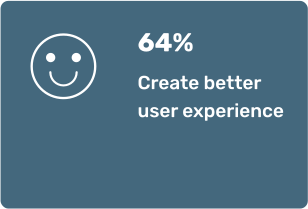
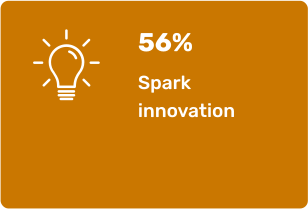
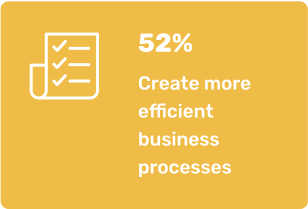
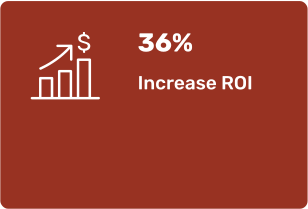
How will IoT impact your business in the next 5 years?

IoT impact on your business with 64% better experience IoT impact on your business will spark innovation by 56% IoT impact on your business will create efficient processesby 52%
IoT impact on your business with 94% return on investment IoT impact on your business will increase ROI 36% IoT impact on your business will create cost savings by 35%


A smarter solution for a typical manufacturing data center is to distribute computing power and storage at the network’s edge to minimize transport latency and bandwidth requirements. Edge computing brings bandwidth-intensive content and latency-sensitive applications closer to the user or data source, so that process visibility is as close to real-time as possible.

With an extensive portfolio of Industrial Ethernet infrastructure, Wi-Fi and media interconnectivity products, Allied Telesis is able to work closely with the manufacturing sector, building state-of-the-art solutions to leverage IoT technology on the plant floor.

San Jose, United States – September 19, 2024 – Allied Telesis, a global leader in intelligent networking, today announces the completed integration of the company’s network switches and API with Canopy’s Remote Monitoring and Management (RMM) platform for connected products. The partnership, announced earlier this year, means that Allied Telesis’s switches can be fully managed, monitored, and troubleshooted remotely within Canopy’s device management software, offering customers clear visibility of their networks and device health, automation of self-healing processes, and minimization of downtime.

Commenting on the alliance, Rahul Gupta, CTO at Allied Telesis, said, “This is a big step forward and we are excited to start delivering our joint Cloud-based solutions. As the first network switch on the market to be Canopy-enabled, we can provide customers one consolidated tool, a single window into their network.”

Telaid, a leading integrator that specializes in deploying and managing complex enterprise technology systems, participated in an early review of the integration with DeviceWatch, powered by Canopy’s remote device management platform. According to Beth Bergmann, SVP of Solution Strategy at Telaid, “The integration of DeviceWatch, which is powered by Canopy, into the Allied Telesis switch sets the foundation for an all-in-one remote monitoring and management platform for computer systems, physical security, and network infrastructure. Proactive monitoring and automated device management eliminate many level 1 tasks, boosting performance and reducing network downtime.”

Similarly, Peter Atwell, SVP of Partnerships and Business Development from Canopy, added, “Our partnership with Allied Telesis marks a significant milestone in advancing remote device management. This collaboration empowers our customers with a unified platform that reduces downtime, simplifies device management, and improves overall network resilience for Allied Telesis switches as well as all other connected products and devices in those environments. We’re thrilled to bring this fully integrated solution to market, adding another unique offering to our elevated standard for proactive device management.”

Allied Telesis will exhibit at the upcoming Global Security Exchange (GSX) 2024 at the Orange County Convention Center, Orlando, FL from the 23rd to 25th September. Visit Allied Telesis to discuss this joint integration with Canopy at Booth #2741.

img746mod.png
dc2552xs-l3_1200_reduced.png
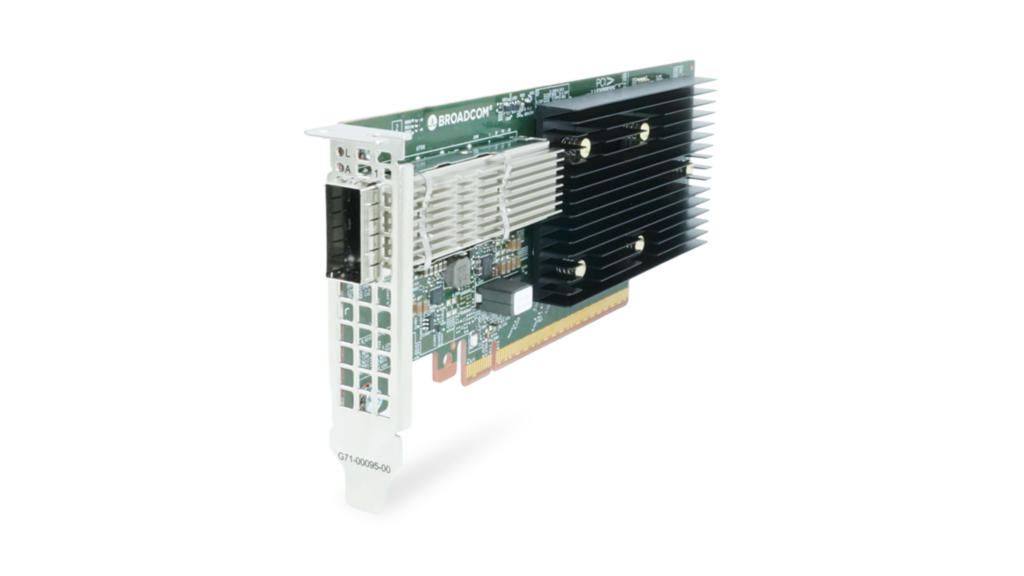
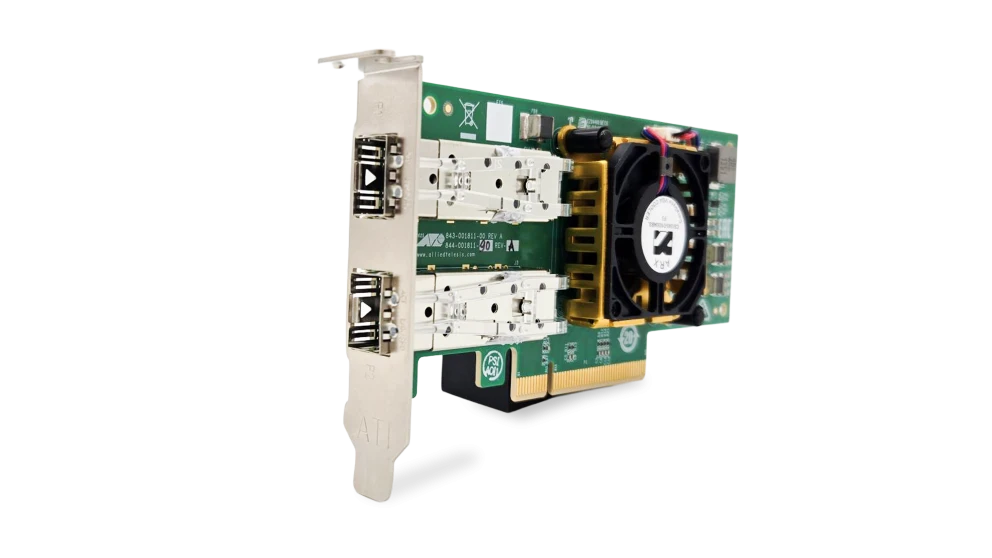
2711 Series NICs
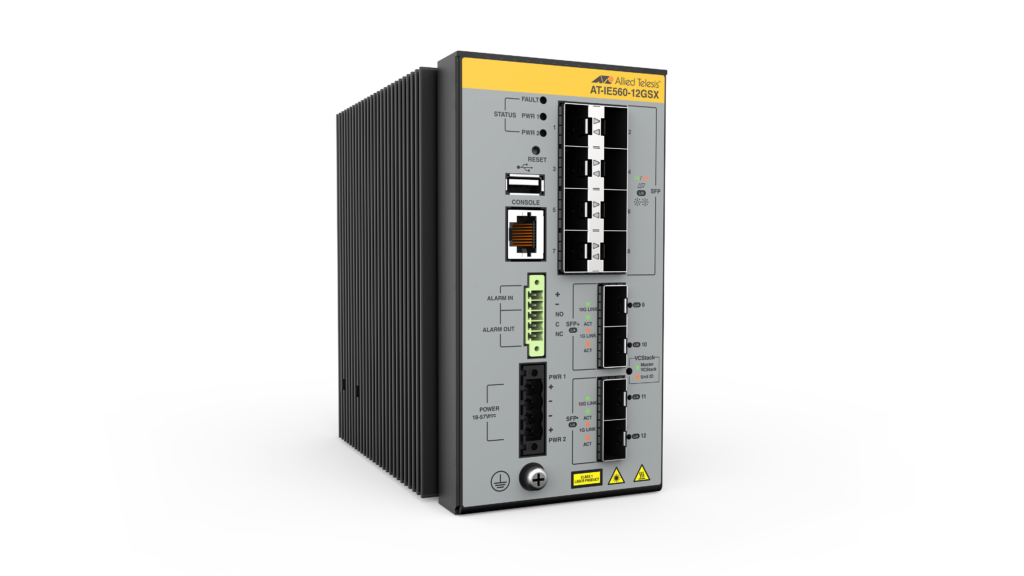
IE560-12GSX industrial switch
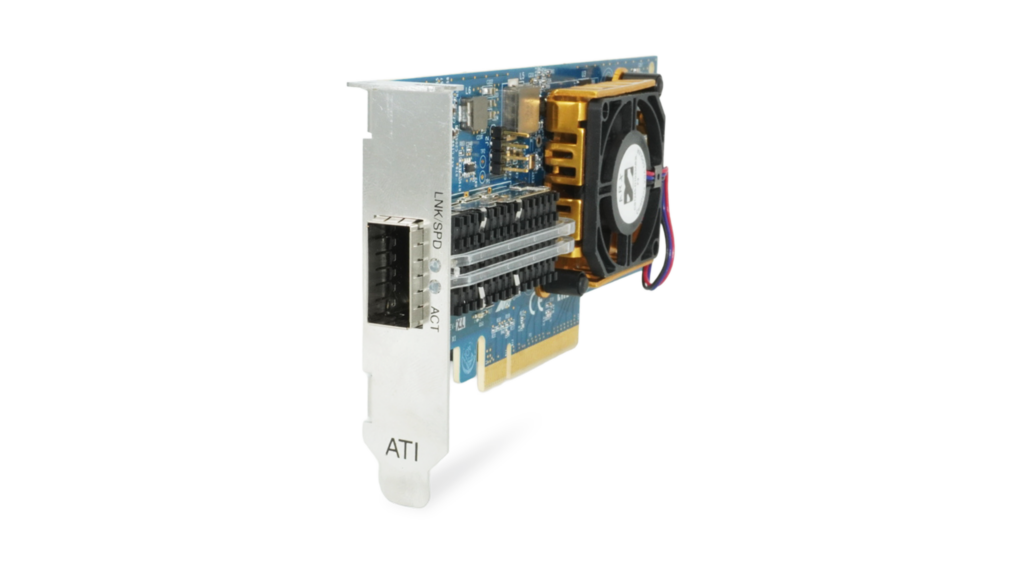
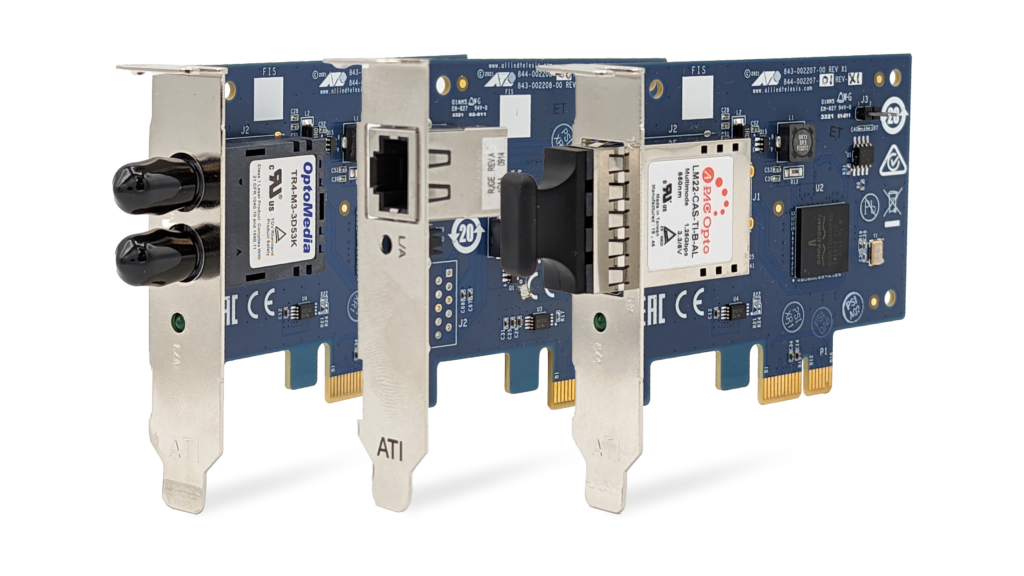
2911a Series Network Adapters
[ninja_form id=65]
This site is registered on wpml.org as a development site. Switch to a production site key to remove this banner.