Service Spring Delivers Precision and Prevents Costly Downtime
Service Spring Corporation (SSC) is a leading manufacturer and distributor in the overhead door industry, primarily serving garage door dealers, installers, and technicians. Founded more than 60 years ago and serving both residential and commercial customers, the company is a longstanding innovator within the industry. SSC’s products include springs, door hardware, operators and parts, weather seal, tools, doors and docks, and a variety of gates.
SSC is best known for its precision manufacturing of high-performance garage door springs, outstanding industry service and support, and extensive distribution capabilities to serve a worldwide network of garage door professionals. The company has ten service center locations throughout the United States, including Atlanta, GA, Baltimore, MD, Chicago, IL, Cincinnati, OH, Dallas, TX, Detroit, MI, Indianapolis, IN, Orlando, FL, Phoenix, AZ, St. Louis, MO, Toledo, OH, and Visalia, CA.
The Challenge: Network Synchronization Failure Halts Modern Manufacturing
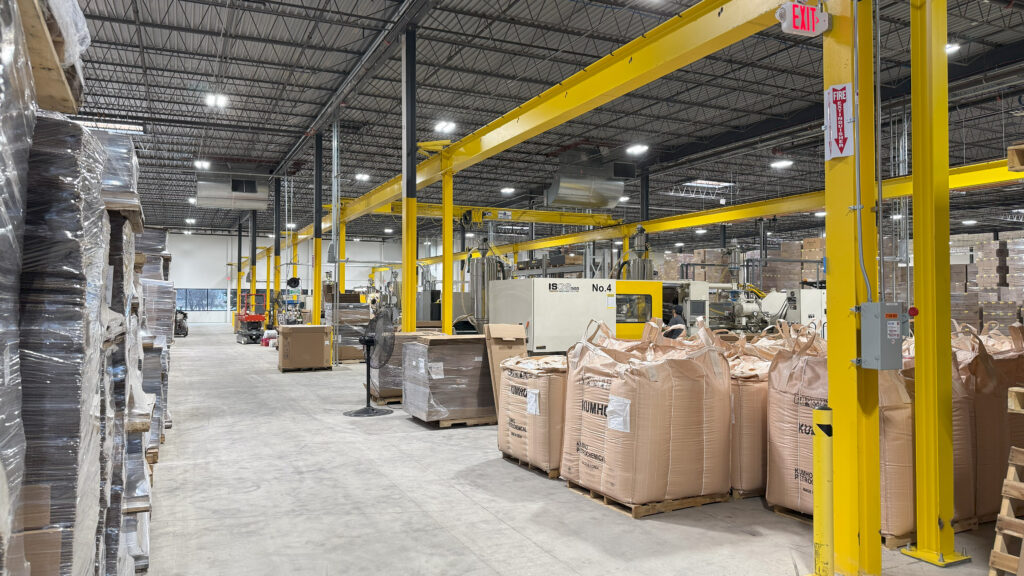
Modern manufacturing is the heartbeat of companies like SSC, where fully automated factory floors transform raw materials into finished products with unmatched speed and precision. Every machine, perfectly timed and coordinated, pushes efficiency to its peak. But for SSC, the outdated legacy network once stood in the way, slowing progress and limiting the true potential of its operations.
Sean Stinner, network engineer at SSC, explains. “Within our manufacturing plant, the network did not fully support CIP/IO (Common Industrial Protocol/Input-Output) and PTP (Precision Time Protocol). The plant networking traffic that was specific for PLCs (Programmable Logic Controllers) was not getting the prioritization required for the manufacturing hardware to work properly. Consequently, the servos and frequency drives would lose their time. Even with an added Master PTP clock, these devices would become locked due to the lack of PTP support.”
Each time a servo or frequency drive went offline, there would be a loss in productivity and a loss in material that would have to be thrown out, according to Stinner.
The problem was unsustainable. For a company relying on tightly synchronized operations, this lack of deterministic communication created costly downtime and prevented SSC from realizing the full value of its modern manufacturing investment. The company had to upgrade its network or face continued production delays, escalating costs, and the risk of falling behind competitors in an increasingly fast-paced market.
The Search: Finding Critical PTP Support Without the Extreme Price Tag
Stinner outlined the company’s requirements for a new network. “Our most critical need is having a network that supports PTP and CIP/IO on all network ports. After that, we would consider the network’s track record for uptime, as well as how long the vendor has been in business and what kind of support they can provide us.” He identified several hardware providers that support the essential protocols for an IIoT (Industrial Internet of Things) network.
Stinner contacted the first vendor on the list and was shocked at the cost it proposed. “This company is known as a market leader in IIoT/PLC networking with support for PTP. I was taken aback by their price tag, so I began looking at other vendors in the industrial networking space,” he says. “Working closely with our plant engineering departments, we were able to look at the pros and cons of the major players. We looked at features/cost and the amount of time the vendor has been in the field to help us decide.”
“Once I narrowed the vendors down by features, support, and price, I evaluated how well they could support our needs, narrowing the choice to two good options to present to our management team.” He didn’t see the need for a full proof of concept project to evaluate the networks.
SSC chose Allied Telesis based on cost of the critical feature set. “The most important feature for us was support for PTP,” says Stinner. “Other vendors had the support, but the cost was extreme. For instance, two of the providers in this space charge a license fee for PTP support equal to the hardware cost. With Allied Telesis, the license fee is a fraction of the hardware cost. We were able to save a substantial amount of money by going with Allied Telesis.”
Seamless Implementation: A Dedicated, High-Availability Industrial Network
The deployment process was straightforward, according to Stinner. He set up the Allied Telesis hardware in a static lab environment, then introduced this new network to the legacy network in a test lab to ensure interoperability. “We are keeping the old network in place to support our business applications and end user traffic,” says Stinner. “The Allied Telesis network supports the manufacturing facilities and is being used to physically separate our networks.” The full deployment was done with internal resources and only took a few weeks.
Among the Allied Telesis products utilized for the industrial network are:
- x250-18XS switches are the core of the PLC network. The switches are stacked for high availability. These switches are distributed to the x230 and IE340 switches in the intermediate distribution frame’s (IDF’s) enclosure. Each x250 switch is also connected to the legacy user network core that uses Meraki MS425 switches.
- IE340-12GT Industrial Ethernet Layer 3 switches enable interconnection of machines, IIoT devices, sensors, PLCs, and more. Most importantly, these switches support PTP and CID/IO to synchronize timing across all connected devices, thus coordinating complex processes, reducing latency, and improving product consistency. These switches have a fiber connection to each x250 for high availability.
- x230-28GT switches provide access at the network edge. In addition, they have fiber connection to the core switches.
The Results: Achieving Deterministic Communication and Future-Proof Stability
SSC is seeing tremendous benefits from the capabilities of the Allied Telesis network and the stability it yields. “The new network is running correctly and is not losing time,” according to Stinner. “With the full support of PTP and CIP/IO, we are experiencing far less downtime within the manufacturing plant.”
Looking ahead, there are plans to use the Allied Telesis Autonomous Management FrameworkTM Plus (AMF Plus) and Vista Manager as the network footprint grows. In addition, the company is planning to replace all unmanaged vendor-supplied switches in the PLC network soon. In light of the positive experience with Allied Telesis, SSC plans to migrate the second manufacturing plant to a similar configuration in the year ahead.